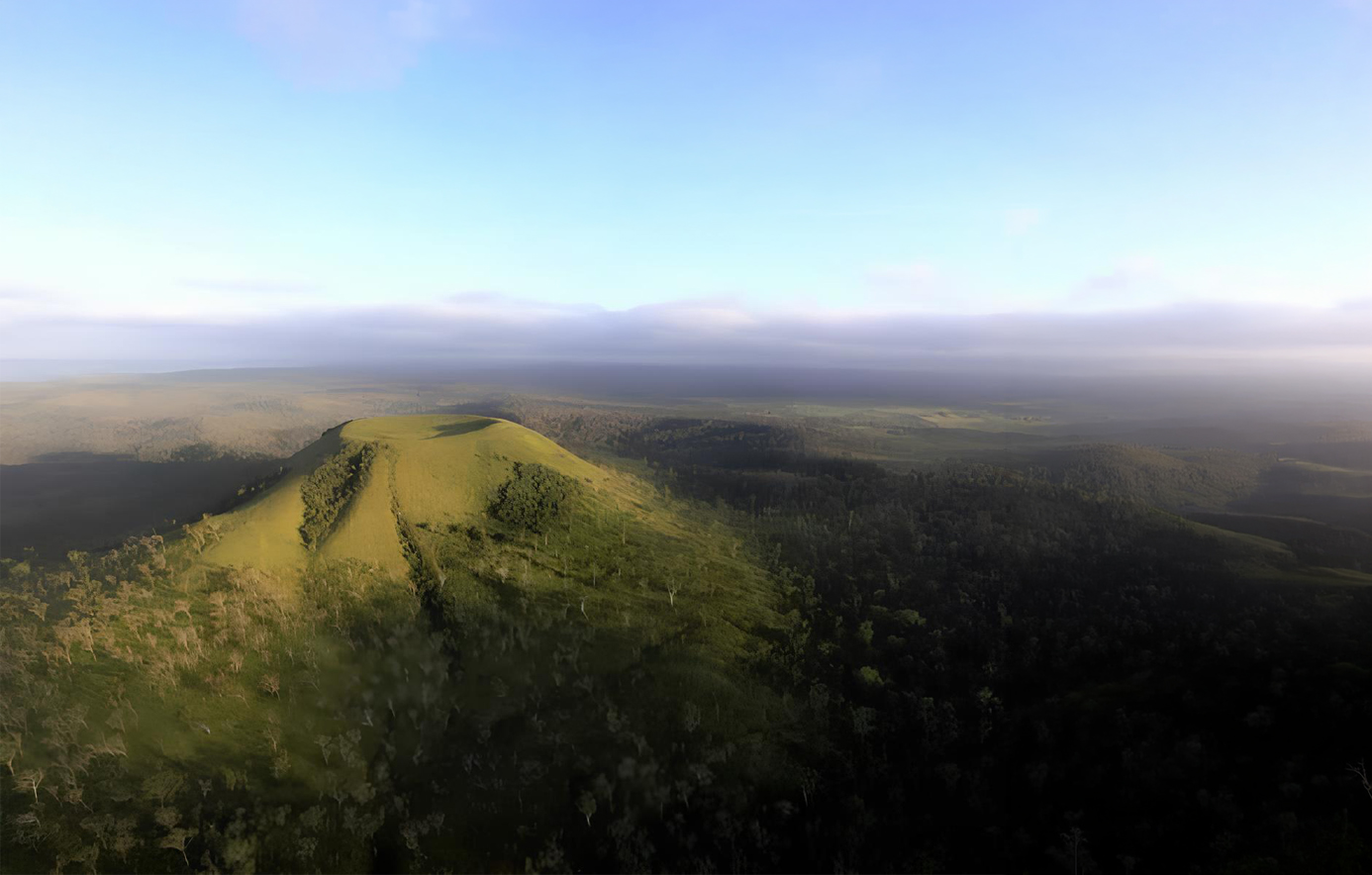
1. Hinchinbrook has a volcano
Around 100,000 years ago, the landscape west of Ingham was transformed by a violent volcanic eruption. The eruption formed the Mount Fox volcanic cone and its shallow crater, leaving behind a striking feature in the landscape.
Today, Mount Fox is a dormant volcano, rising above the surrounding countryside as a reminder of the region’s past — and of just how recently volcanoes were active here.
2. The ‘Cube’ that isn’t a cube
High among Hinchinbrook Island’s peaks is a natural rock formation that, from a distance, looks impossibly geometric. So much so, it sparked the tongue-in-cheek local suggestion that it was placed there by aliens.
But get closer and the illusion disappears. Shaped by weathering over enormous periods of time, the formation is not cube-like at all. It is a natural visual phenomenon created by the light and the angle from which the rock is viewed from the mainland.
3. Hinchinbrook Island is enormous
Hinchinbrook Island is one of Australia's largest island national parks, covering around 39,900 hectares, or about 399 square kilometres. That’s bigger than the entire country of Malta! It’s roughly the equivalent of 56,000 standard soccer fields packed into one spectacular island.
4. The soil was made for sugar
The first cane planted in the Herbert River Valley was in 1868m just 4 years after explorer George Dalrymple travelled through the region in 1864 where he described the area as “undoubtedly the best suited” for growing sugar in Queensland.
The combination of fertile alluvial soils, tropical rainfall and the Herbert River made the district ideal for cane, with the crop eventually becoming the backbone of the local economy.
5. It’s home to Australia’s highest permanent single-drop waterfall
Wallaman Falls plunges an incredible 268 metres from Stony Creek into the gorge below, making it Australia's highest permanent single-drop waterfall. To put that into perspective, the Eiffel Tower stands at 330 metres to the tip of its antenna.
Contact Info
Phone:
0417267373
Business hours:
Mon - Fri: 8 AM - 5 PM
Sat - Sun: Closed
Publishers Indemnity. Any individual or entity that places advertising, supplies copy material, or submits editorial content to Core Life Publishing agrees and undertakes to ensure that all such material:- Does not infringe upon any copyright, trademark, or other intellectual property rights;- Is free from any content that could be considered defamatory, libelous, or slanderous;- Does not infringe upon any rights related to privacy or breach of confidence;- Contains no obscene, indecent, or otherwise unlawful material;- Complies fully with the Trade Practices Act and all other applicable laws, regulations, or statutes.Furthermore, by submitting or placing such material, these individuals or entities agree to indemnify and hold harmless the publisher, Core Publishing and Events Pty Ltd, and/or its agents from and against any and all investigations, claims, demands, liabilities, damages, costs, or judgments arising out of or in connection with the material provided. All material is believed to be accurate at the time of printing and remains the copyright of Core Publishing and Events Pty Ltd.
© 2026 Tripping Magazine Pty Ltd. All Rights Reserved